
Studying connections to a society beyond “barrier free” – Report on the movement accessibility workshop at the 9th AHEAD JAPAN Conference.
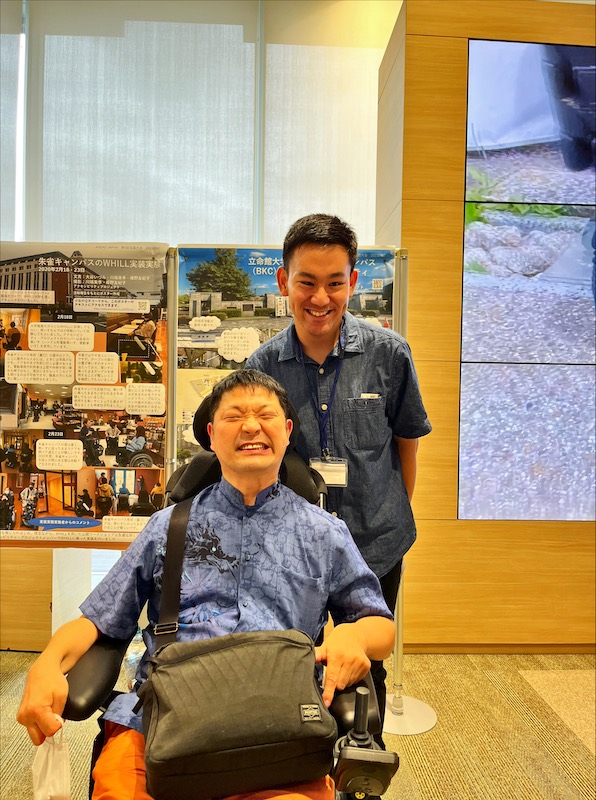
The 9th AHEAD JAPAN Conference was held on September 7th and 8th, 2023, at Ritsumeikan University’s Osaka Ibaraki Campus (OIC). On the first day of the conference, the Institute of Ars Vivendi Accessibility Project, in which I am participating, held a “wheelchair movement accessibility workshop” that included an opportunity to try riding in a WHILL electric wheelchair along with a report on our activities up to this point.
At the wheelchair test riding event, we had participants directly experience physical barriers wheelchair users often face, such as getting on and off elevators and opening and closing classroom doors, while moving around the campus in a wheelchair. After this we held a simple opinion exchanging exercise with those who took part. Participants said things like “it was difficult to operate the wheel chair, open and close the doors, and get on and off at the same time when using an elevator,” “doorknobs and elevator buttons are not at the right height for wheelchairs,” and “if I ran into rainy weather or a steep hill when using a wheelchair by myself, I think it could be quite scary.”
When they tried riding in an electric wheelchair that seems highly convenient at first glance, they saw that within the university campus there are situations in which they could not get around smoothly. Even within the OIC precincts where new barrier-free equipment, such as braille blocks with reduced unevenness and sliding doors, have been installed, they encountered situations in which smoothly moving around was difficult because of the uneven degree to which the facilities have been made barrier free. At present, there is still a mix of elevators with and without mirrors installed, classrooms with and without desks designed to accommodate wheelchairs, and lecture halls with and without aisles wide enough for wheelchairs navigate.
While conducting the workshop, I once again realized that we must not stop at “barrier free” measures that create a visible environment where difficulties in movement do not arise because of physical barriers, but carefully consider the true meaning of “barrier free” while focusing on how we can reduce people’s mental burdens that can make it easy for difficulties in movement to arise.
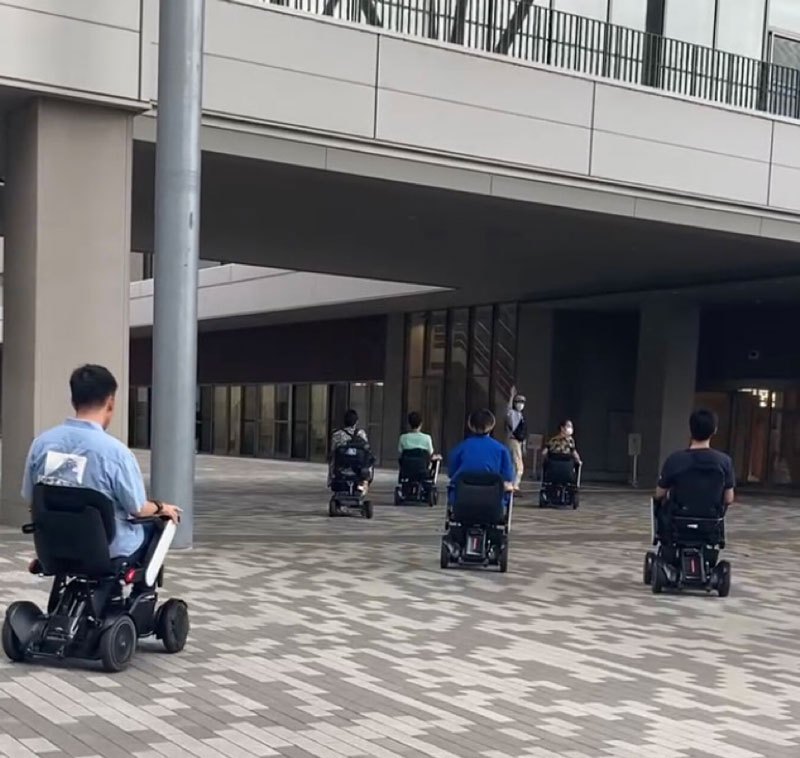
I have already found myself worrying about things like “Am I going to injure the people around me by catching them with my wheelchair?” or “Am I bothering people?” when getting into and out of elevators in the wheelchair used in the test rides. When struggling to open and close doors while seated in a wheelchair, I have also felt “it takes courage to ask a passerby for help.” I had this worry because it had occurred to me that “most people may not necessarily be willing to help.”
Through this experience, I realized that while “calling out” to someone who is having difficulty in front of you and saying something like “is there something I can do to help?” might lesson the psychological burden of mobility, when we consider people whose condition makes it difficult for them to speak, “calling out” might not be of any use in reducing the psychological burden of someone having difficulty getting around. I started to think about what kinds of communication might be possible and might reduce the psychological burden in cases in which someone cannot answer well or cannot respond at all when someone calls out to them offering help.
In other words, “barrier free” as a means of supporting the lives of persons with disabilities requires us to think about methods that anyone can use confidently and without anxiety in combination with establishing an environment that anyone can use safely.
I have been currently studying issues that arise between the concept and practice of “barrier free” and universal design. This workshop was therefore an opportunity for me to concretely deepen my own research.
Without letting this learning go to waste, going forward I would like to explore forms of interaction between disability and society that lie beyond “barrier free” to help those living lives of restricted freedom.
Taiki Taba
(Graduate student, Ritsumeikan University Graduate School of Core Ethics and Frontier Sciences)