
Rethinking the ethics of decision-making regarding life and death
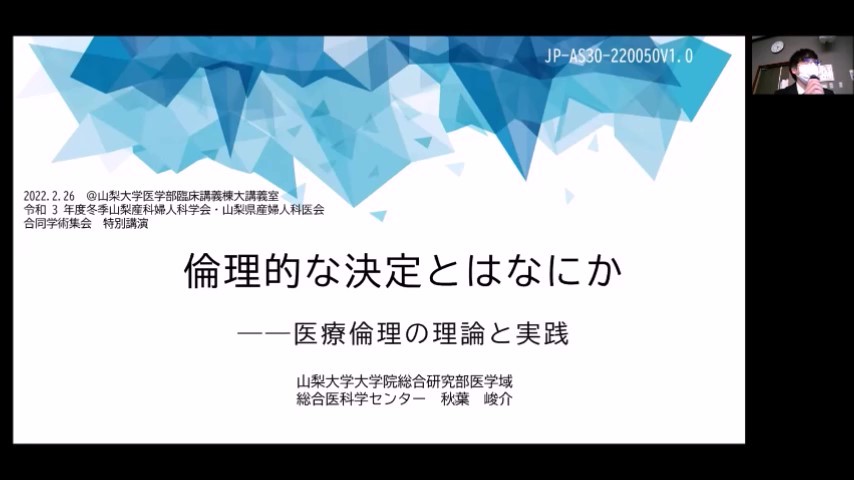
While engaging in education and management regarding bio ethics, medical ethics and research ethics in the faculty of medicine, I have also been conducting my own research on decision- making regarding life and death. I suspect some readers may have heard the nickname “life meeting” that has been used for decision-making regarding medical treatment and care during the so-called “last stage of life” by the Ministry of Health, Labor, and Welfare to promote the spread of advance care planning (ACP).*1 In this context I have examined various questions, such as why ACP has been promoted and actively introduced in places where medical care is provided and what sort of theoretical and ethical debate has unfolded.
Decision-making regarding life and death has been discussed from various angles, such as the issue of diagnosis notification, the legal and ethical debate over informed consent (IC), and the debate over shared decision-making (SDM). Moving away from paternalistic medicine and transitioning to a system that respects patients’ autonomy and values has been presented as the starting point of this discourse. As a broad trend, this can be summarized as IC based on autonomy and self-determination appearing, forms of recording decisions in advance such as advance directives and living wills being brought in to compensate for IC’s theoretical and practical limitations, and a focus on the importance of family members and medical professionals sharing patients’ preferences and desires leading to the development of SDM and ACP.
In the context of these trends, I have focused in particular on the entity of “the family” and its role. In the debate over decision-making discussed above, it has been assumed that decision-making is to be carried out through patient autonomy and self-determination. This alone does not work, however, and since supplementary or alternative methods were needed SDM and ACP were introduced. Here the patient, medical professionals, and society at large expect the family to play a certain role, and it has become clear that cases in which decisions cannot be made without the family’s opinion are not uncommon. If so, the family is presumably an element constantly present in the background of the debate over decision-making regarding life and death, but in a discussion focused on patient autonomy and self-determination it has not been possible to give a consistent explanation of why families are capable of augmenting the autonomy of patients or serve as their proxy. I think it is necessary to make this clear, or, in other words, to elucidate how the family has been positioned and come to function in the debate over notification, IC and SDM that has developed with patient autonomy and self-determination at its core and in the policies and practices that have emerged based on this discourse.
![Photograph 2: Left: Akiba Shunsuke, “Infoomudo konsento ni okeru Kazoku no ichi to kinō –– kanja – Kazoku iryōsha no sansha kankei ni chakumokushite [The Position and Function of the Family in Informed Consent –– Focusing on the Three-party Relationship of Patient – Family – Medical Professionals” in Igaku tetsugaku igaku rinri [Journal of Philosophy and Ethics in Health Care and Medicine] 38 (2020) pp. 1 – 10. Right: Akiba Shunsuke, “Iryō・kea wo meguru jikokettei ni okeru jita kankei to kankeiteki jiritsu [The Relationship between Self and Other and Relational Autonomy in Decision-Making Surrounding Medical Treatment/Care] in Seimei rinri [Journal of Japan Association for Bioethics] 32 (2021) pp. 46 – 54.](https://www.ritsumei-arsvi.org/wp-content/uploads/2022/03/photo02.jpg)
As I mentioned at the start, SDM and ACP have received a lot of attention in the discourse on the “final stage of life,” and in recent years their use has rapidly spread. However, the debate over SDM began in 1972 with the Hastings Center Report and discussion of IC began around the same time, and these are not new topics in the context of psychiatry and the debate over the protection of the rights of people with disabilities. If so, it can be posited that the focus on SDM and ACP is not only a result of the limitations of autonomy and self-determination. “Something” driving a conceptual, social shift from autonomy to sharing (cooperation) and relationships may indeed be exerting a latent influence. In thinking about these issues, I have drawn on discourse from a feminist perspective and care ethics. In the discourse on feminism and care ethics relationships and family are always core topics. The reexamination of concepts of autonomy and the family from these perspectives has also influenced the discourse and orientation of bioethics and medical ethics in the past and can be said to continue to do so today. If SDM and ACP focus attention on achieving shared (cooperative) decision-making and decision-making that emphasizes relationships, they can perhaps be described as compatible with care ethics and feminist discourse. I cannot completely agree, however, with the claim that care ethics and feminism have linked “final stage of life” decision-making to SDM and ACP and promoted these approaches. It can indeed be understood that from a feminist perspective the involvement of family does not infringe on autonomous agency but rather preserves it, and that this highlights the importance of consideration of the happiness of the family in terms of its interpersonal relationships. If so, however, then conversely this implies that neither care nor SDM nor ACP can emerge in families without good or ideal relationships. A more delicate analysis is therefore required regarding how care ethics and feminist discourse is related to forms of decision-making and trends in bioethics and medical ethics.
Through my research I have come to believe that the existing discourse over decisions regarding life and death requires reversion to a private domain that assumes the existence of an ideal
family. In other words, when it comes to extreme circumstances surrounding medical care and life and death, in this debate there is an “ethics” that assumes that a family exists and that this family will provide care and support for the autonomous decision-making of the patient. Going forward, by critically examining this schema I aim to develop research that rebuilds the ethics of decision-making regarding life and death from the ground up.
Akiba Shunsuke
(Senior Assistant Professor, University of Yamanashi Center for Medical Education and Sciences/Student, Graduate School of Core Ethics and Frontier Sciences, Ritsumeikan University)
*1In 2018 the Ministry of Health, Labor, and Welfare put out a call for a “nickname” for “ACP,” and “life meeting” was selected from the submissions received. In 2019 posters featuring celebrities were made to promote “life meetings,” but following criticism from patients’ groups and other parties the ministry halted distribution of the posters to local authorities throughout Japan. These “life meeting” posters sparked a debate regarding not only the posters themselves but also various issues surrounding “life meetings.”