Healthcare Grounded in People’s Daily Lives
While teaching biology and ethics at a nursing school, I have also been conducting research on the history of community healthcare. Why did I—someone who is neither a healthcare professional nor has practical experience in healthcare or welfare—develop an interest in healthcare? It is because I came to understand healthcare and welfare as belonging to the realm of human life itself, inseparable from our everyday existence.
Although technologies and institutional systems change over time, the very existence of life is continually embodied in the ways people live, in every era. From this perspective, I realized that healthcare is inherently connected to the communities that form the foundation of our daily lives. This realization led me to begin my research on community healthcare.
“Community healthcare” is a term that began to gain currency in the 1960s. Today, national and local governments, as well as university hospitals and clinics, all emphasize its importance and advocate patient-centered care. However, what “community healthcare” actually entails, and what it concretely means to “take the patient’s perspective,” remain difficult to grasp—even when we examine the recent development of the Community-based Integrated Care System.
“Taking the patient’s perspective” depends on broadly reciprocal relationships. Patients, their families, and healthcare providers are all embedded in the community, where their ways of living and personal backgrounds take shape. In such a context, mutual understanding and trust can be cultivated over time, and both healthcare providers and residents can be seen as situated within this shared environment.
From this perspective, “community healthcare” may be understood as healthcare that is responsive to the diverse needs of the community, grounded in relationships of trust. If so, the issue of “community healthcare” is not merely a matter of healthcare itself, but also a question of the nature of the community.
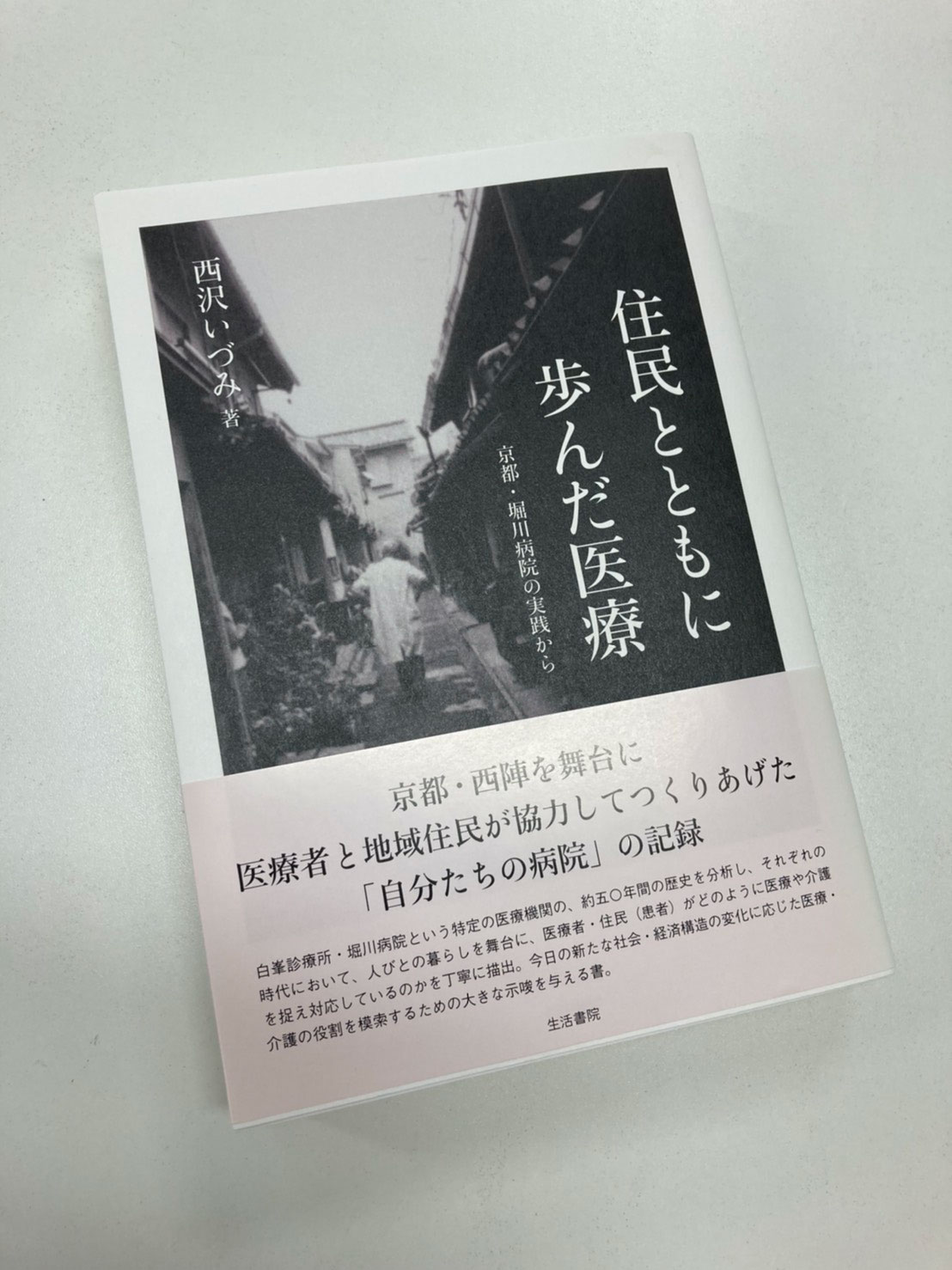
From this perspective, I wrote my doctoral thesis on the history of community healthcare in the Nishijin area of Kyoto. With revisions and additions, it was later published as Healthcare Practiced in Partnership with Residents: The Experience of Horikawa Hospital in Kyoto.
Horikawa Hospital, a medical corporation located in Nishijin, Kyoto, has a history of seventy years as of 2021. This book focuses on the approximately fifty-year period from 1950, when its predecessor, the Shiramine Clinic, was established, to 2000, and traces the development of healthcare practices carried out by both residents and healthcare providers. In doing so, it clarifies how these community-based activities, grounded in people’s everyday lives, shaped healthcare and welfare.
Immediately after the war, various movements for “democratization” emerged in Japan under the occupation of the GHQ. In the Nishijin area, a movement to “protect our own health ourselves” developed, led by welfare recipients and those not enrolled in health insurance. This movement converged with healthcare providers’ initiative to work “together with residents and within the community,” evolving into a broader community-building movement that led to the establishment of the Shiramine Clinic.
Although the Shiramine Clinic was established as a medical corporation, it was funded by local residents. When it was reorganized into Horikawa Hospital in 1958, residents’ organizations became involved in its management. From the outset, residents and healthcare providers collaborated in integrated activities encompassing healthcare, public health, and welfare, including the sharing of medical information, improvement of living conditions, and efforts to secure access to medical assistance. These activities can be understood as an integrated framework supporting everyday life.
Because everyday life was central, home visits and home-based nursing care were indispensable. Building on this foundation, efforts were made in the 1960s to integrate facility-based medicine utilizing advanced medical technologies with community-based care. In the 1970s, home healthcare and visiting nursing became central components of measures addressing the needs of the elderly. In the 1980s, local residents actively participated in home care support, further strengthening community engagement.
However, from the mid-1990s onward, with the introduction of visiting nursing services and the long-term care insurance system, as well as changes in the composition of the local population, community-based activities gradually declined. Today, residents are no longer directly involved in hospital management, and the institution continues to function as a community hospital primarily focused on general medical care and home-based care support.
I found that in Nishijin, the key actors in both “community” and “healthcare” lay in everyday life and in the people who lived there. When these activities declined, the lives of individuals within the community became increasingly subsumed under public systems.
If today’s concept of community-based integrated care can be understood as an integrated framework of healthcare, welfare, and public health grounded in everyday life, then the locus of agency and the relationship between residents and healthcare become crucial.
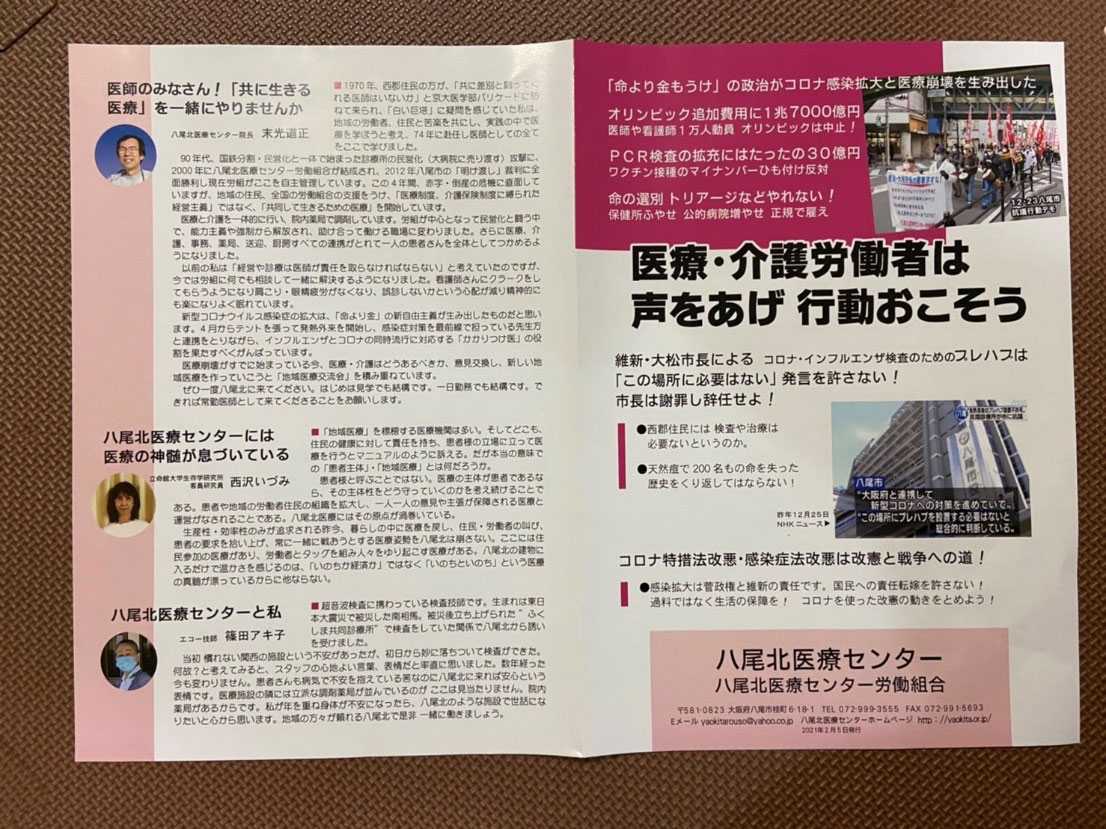
I am currently examining the history of the Yaokita Medical Center in the Nishigōri area of Yao City, which developed in conjunction with the Buraku liberation movement. By reassessing its significance, I aim to explore the future of community healthcare.
Nishizawa Izumi
Visiting Research Fellow, Research Center for Community Health and Social Studies, Ritsumeikan University