
The Multilayeredness of Not Being Romantically/Sexually Attracted – The Practice of Asexual People Themselves
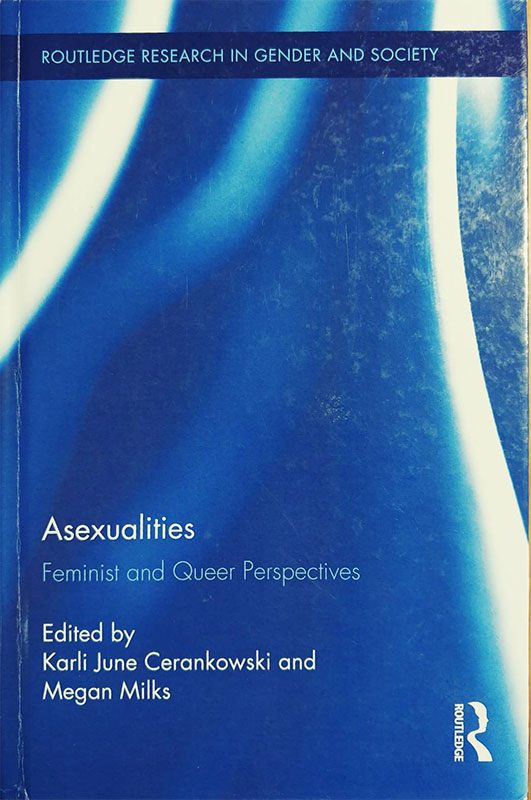
I have been involved in LGBT organizations since my undergraduate years. This experience has given me doubts about various metaphors and social conventions surrounding sexuality (that it is dirty or must be kept secret). After graduating I worked at an obstetrics clinic and thereby came to have a stronger interest in the nature of sexual love. In the context of encountering many people classified as having a sexual disorder or pain during intercourse according to the categories of sexology, I became aware of the question of whether it is possible to envisage a realm of narratives of sexuality where sex is not a prerequisite. On this basis I considered how asexuality as the “absence” of sexuality is to be positioned. Even in the queer studies and feminist theory that had addressed differences and diversity in gender and sexuality, there had been hardly any discourse on the “absence” of sexuality. This may be related to the fact that it is impossible for asexuals to express themselves within the existing framework of sexuality.
Unlike other sexualities, asexuality is difficult to define. Within the community an asexual is defined as “a person who has never experienced sexual attraction to another person,” but among these asexuals there are some people who have experienced feelings of romantic love, and there is a separate concept of “romantic orientation” distinct from sexual orientation that has led to the creation of concepts between sexual and asexual such as greysexual and demisexual. Diversity has been subsumed by viewing the concept of asexuality broadly.
Looking at trailblazing research in the English-speaking world, opposition to pathological discourse in which asexuality is viewed as a sexual disorder has grown, and advocacy of the need to reconsider society’s “sexuality normativity” that takes romantic love and sex as a given has emerged. I would like to elucidate how asexual people themselves express and practice their own sexuality. In my research I would also like to reveal the actual content of the sexual normativity upheld by Japanese society. I believe the study of asexuality will not only allow us to learn about asexuality itself but may also one day lead to potential thought and practice, including for heterosexual people, regarding the nature of sexuality going forward and ways of life not captivated by sex.
I had long thought that because various forms of knowledge concerning sexuality are required, the study of asexuality needs not only the queer studies but also interdisciplinary exchange. And having experienced a lack of opportunities to connect with other students interested in gender and sexuality since my undergraduate years, I also thought we had to construct a human network ourselves. To this end in 2019 I collaborated with Ouyang Shanshan, a classmate at my current institution, the Graduate School of Core Ethics and Frontier Sciences, and another doctoral student to establish the SOGI Research Group using the internal graduate student project system. “SOGI” stands for “Sexual Orientation and Gender Identity.” In this research group, we aim to examine a wide range of issues from the perspective of SOGI.
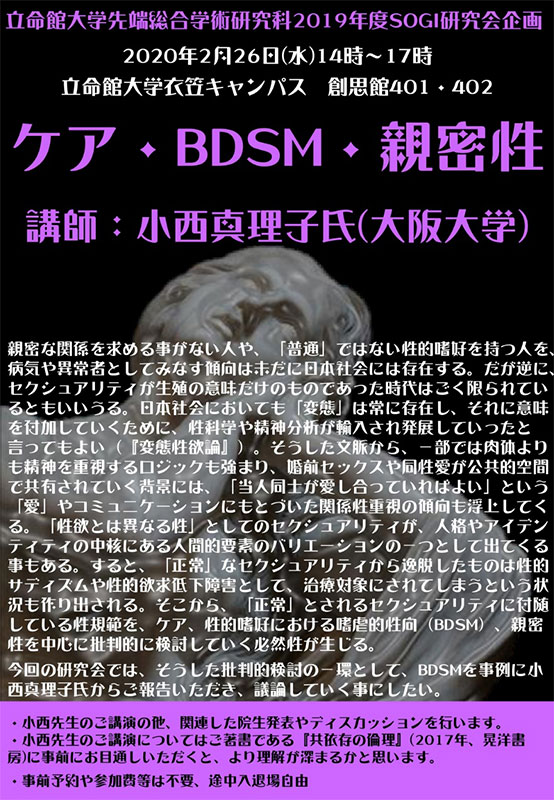
In our first year we had only three members, but with each research presentation and seminar the number of participants increased. Today we have reached the point of adding participants from outside our institution, and I am responsible for planning reports on the results of seminars and selecting readings. In book study meetings and seminars we have read works such as Judith Butler’s Gender Trouble and Eve Sedgewick’s Between Men: English Literature and Male Homosocial Desire. Once each year we also invite a scholar from outside our institution and report our research results. Our research report in 2019 was on the themes of “Care, BDSM, Intimacy.” We invited Professor Konishi Mariko from Osaka University and presented a critical consideration of the sexual normativity attached to sexuality that is considered “normal” with a focus on care, a tendency toward sadism in sexual preference (BDSM), and intimacy. In 2020 we invited Takeda Keiko from Ochanomizu University and deepened the discussion of the social practice and intersectionality of sexuality and art by examining [artist collective] Dumb Type and the themes of “Sex, Art, Relationships.” In this way the SOGI Research Group has been very useful in my own study of asexuality. Going forward I hope to continue to utilize the initiatives of this group in my own research.
Nagashima Shiori (Graduate student at Ritsumeikan University’s Graduate School of Core Ethics and Frontier Sciences)