
Wheelchairs × textile accessibility – Collaborating with Tansan Design Studio at BKC Welcome Day / Ibaritsu Day 2025
The Institute of Ars Vivendi Accessibility Project took part in Ibaraki x Ritsumeikan Day 2025 (Ibaritsu Day 2025) held at Ritsumeikan University’s Ibaraki Campus (OIC). We are conducting a project, “Thinking about a future with wheelchairs ~on-campus adventures in a wheelchair~,” that aims to create opportunities for thinking about movement accessibility on campus.
The Accessibility Project also took part in campus events at OIC and the Biwako Kusatsu Campus(BKC) in 2024. People who participated at each location talked about things like “the ease of riding electric wheelchairs”, “the difficulty of opening and closing doors while in a wheelchair,” and made comments like “the wheelchair I got to try riding in was cool and futuristic.” The events held at BKC Welcome Day and Ibaritsu Day 2025 involved more than just trying out wheelchairs.

In this project, we have engaged in discussions on wheelchair design with Katsushi Yoshii and Yoshitake Kitaguchi from JSSJ (Joson Safety Systems Japan). A focus on questioning the approach to design that is determined by practicality and caregivers and limits the choices of users has led to the idea of “a wheelchair that melts into our lifestyle.”
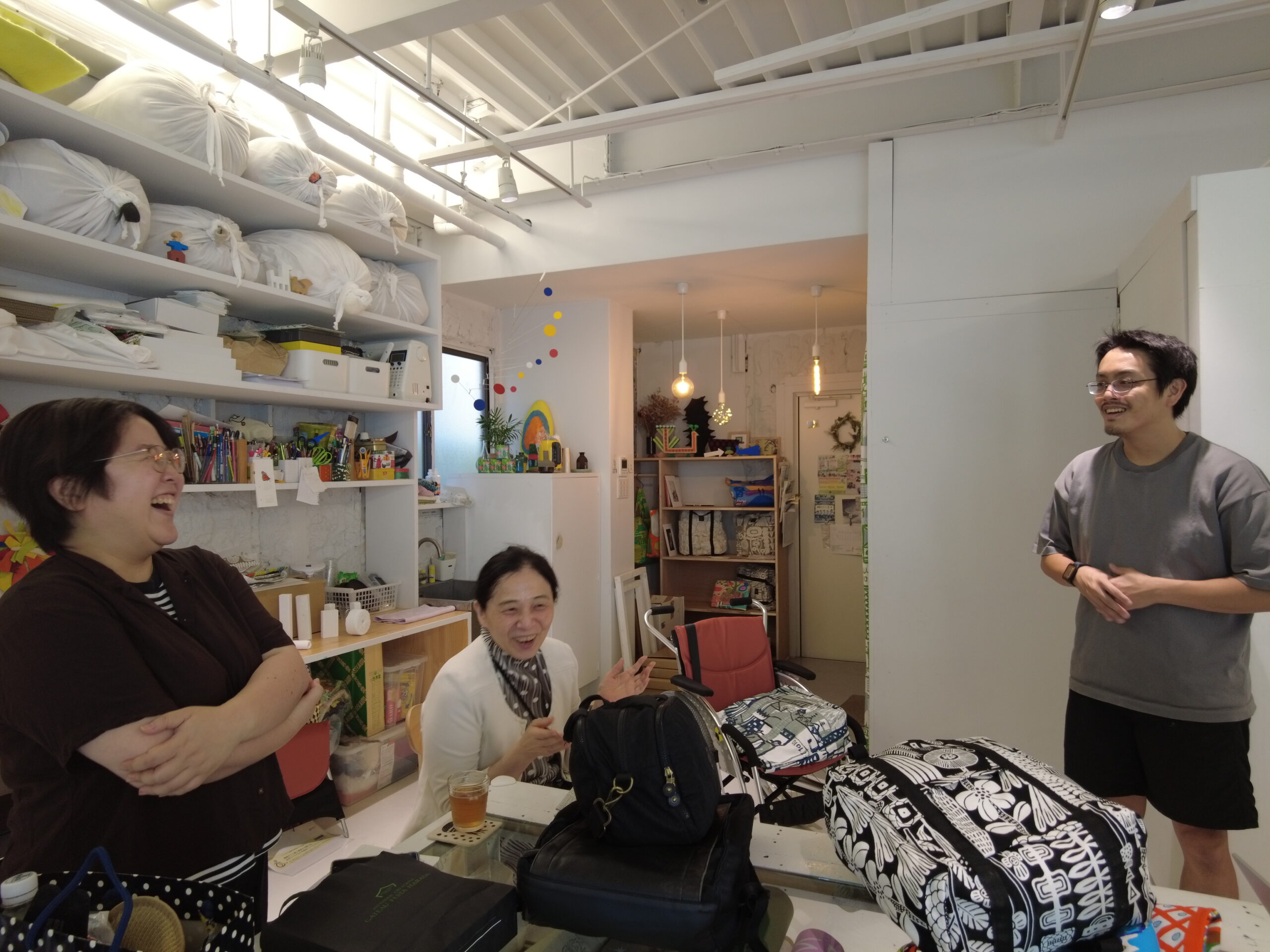
In July of 2024, having been introduced by JSSJ, I visited Tansan Design Studio, a textile design studio in Shiga Prefecture, together with project leaders Izumi Otani and Miki Kawabata. Stepping into the studio, we found a large, colorful worktable right in the center of a spacious room. The wall on the other side of the table was filled by a large window. Lace curtains with a floral design covered the windowpane, and light streaming through the fabric created a flower garden of shadows on the floor.
Tansan Design Studio’s keywords are “lifestyle,” “unspoiled landscape,” and “memory.” The visual impression created by the curtains was enough to give me a sympathetic understanding of this studio’s way of thinking.
The ordinary “wheelchairs” we are used to seeing are connected to an image of “hospitals,” “no sense of design,” and “being unrefined with a lack of individuality.” A hint to shaking up this image can be found in “textiles” – designs that are practical, cute and cool.
Even electric wheelchairs, devices with a futuristic aspect, have a limited color scheme. Steve Jobs, with a closet full of black turtlenecks, may have been satisfied with a monochrome design, or may have wanted to receive a wheelchair with bright accents of yellow and red as a new body. Simple coloring without patterns enjoys a certain popularity as a mainstream trend, and some people may find the works of Tansan Design Studio slightly garish. But something about the daytime and nighttime expressions of mountain ranges, verdant paddies in the summer rice-planting season, and power lines for electric trains running above our heads found in these works gives us a nostalgic feeling.
As soon as we arrived, Tansan Design Studio’s Tomoaki Mizuno and Wakana Ina told us that they emphasize the idea that “textiles connect people to their lifestyle.” This idea resonated with us, and we felt that we have been proposing the same approach when considering the design of wheelchairs. The aim of the Accessibility Project has been changing lifestyles by thinking about wheelchairs. Tansan Design Studio’s motto is “Delivering a bit of fizz to the lives of others [“Tansan” means carbonic acid, as used in carbonated drinks]. Mizuno said, “at first glance our designs may seem garish, but we hope they seep into your lifestyle as you carry them with you and make it more fun.” While on the one hand aiming at social change through social practices, on the other hand they aim at everyday change through design. These efforts complement each other as they strive to loosen norms.
The image evoked by a “wheelchair” cannot escape being characterized as limited when it comes to textile materials and design. This object that tends to be spoken of in terms of a narrow image has a latent potential to change by focusing on “cloth.” In the Tansan Design Studio space, we combined a prototype wheelchair with one colorful fabric after another. It was just like trying on clothes in a changing room and showing them to the people around you. It was like the wheelchair changing quickly and opening the curtain to consult with an attendant. We got to experience directly how much changing the design of the seat can change the impression people get of the wheelchair. “Wouldn’t it be great if we could change the wheelchair’s cushion and backrest too, just like people putting together an outfit?” In this friendly environment, we all envisioned a future in which wheelchairs, textiles, and people are connected.
The user can “dress” their wheelchair differently depending on where they are going and match their wheelchair to their clothes. In this way, changing textiles depending on the user’s needs and environment becomes possible. Users and designers, while each being in their own domain with their own perspective, bringing each other ideas and refining them into a unified form – this is an approach that can change the design of society.
“My legs work so it has nothing to do with me.” “I am always going to have a healthy body, so I have no connection to wheelchairs.” While strongly challenging whether this is truly the case, I hope what we attempted this time will be an impetus for users with and without disabilities to enjoy their lifestyle with a wheelchair.
Sayaka Miyauchi
(Graduate student, Graduate School of Core Ethics and Frontier Sciences, Ritsumeikan University)