
Mapping Aural Diversity through In Which to Trust?
Jay Afrisando*
* Assistant Professor of Music, University of California, Santa Cruz, California, US. Email: jafrisan@ucsc.edu
Abstract: In sound-related scholarship and practice, the general understanding of hearing-listening remains constructed around ‘normal’ hearing, while in fact, people live on a spectrum of hearing-listening. Nonetheless, although various hearing-listening experiences have been documented in writings and artistic works, such accounts are challenging to find, mainly because the ‘normal’ hearing is deeply ingrained in our society, and the general public may not know the right keywords to search for hearing-listening diversity. A film installation work In Which to Trust? was then created by Jay Afrisando as an arts-based research project to map aural diversity, inviting the public to rethink their understanding of sound and serving as an alternative form of knowledge accessible to the general public. The project uses sound captions, written by five aurally diverse listeners, as an artistic element that conveys aural interpretations of a series of audiovisual sources. Across several public presentations in various exhibition spaces, this project has been realized in several ways, with the artistic style and accessibility improved and critical conversations sparked in line with each exhibition context. In a temporary conclusion, In Which to Trust? has shown that arts-based research practice can generate accessible, alternative knowledge through accessible artistic forms and collaboration among research participants.
Keywords: Aural Diversity, Hearing-Listening, Aural Experience, Soundscape, Mapping, Arts-Based Research, Sound Caption
How does sound actually “sound”? This article discusses In Which to Trust? (Afrisando n.d.b; Afrisando n.d.a), my five-channel film installation created in collaboration with five sound captioners with various hearing-listening profiles: Bill Davies (autistic and Hard-of-Hearing), Josephine Dickinson (Deaf and cochlear implantee), Ed Garland (a person with tinnitus), Alan Jacques (a person with Ménière’s disease), and Terry Perdanawati (a ‘normal’ hearing person).
In Which to Trust? maps aural diversity and invites audiences to rethink their understanding of sound through five sound captions written by the captioners that reveal how vastly different our actual listening conditions and capacities are. The differences between the sonic sources and the various captioners’ interpretations leave us a choice of what we should refer to when talking about sound: the objects, our hearing-listening apparatuses, or both? In which will you trust? In Which to Trust? centers on diverse aural experiences as a vital form of knowledge and blatantly exposes how the notion of sound still glorifies the idealized, healthy, and ‘normal’ pair of ears.
In this article, I will describe the motivation and objectives behind the work, explain the methodology, and discuss the outcomes.
Assumptions and Inaccurate Presuppositions on Hearing and Listening
Aural perception and soundscape have been studied extensively in various fields of knowledge. Yet, how individuals perceive soundscapes differently remains a significant mystery. There are tacit assumptions and inaccurate presuppositions about hearing that form the basis for the general understanding of aural perception and soundscape.
First, it is assumed that everyone hears the same, while in fact, people live with a spectrum of hearing and listening that ranges from d/Deafness, Hard of Hearing, neurodivergence, tinnitus, hyperacusis, and chronic illnesses, as well as hearing-listening conditions that change over time and within various situations (Drever and Hugill 2022). Second, hearing remains assessed quantitatively through technologies outside the body, separate from subjective experience, and divided from listening—the same epistemic history of modern physiology, acoustics, medicine, engineering, and psychoacoustics that sound studies tend to repeat (Sterne 2015, 68). Third, researchers assume they have full access to someone’s hearing, whereas in fact they can have full access to hearing as a pure faculty when the subject’s listening is highly cultured, as indicated by the reactions of the person who perceives (72).
We cannot understand the faculty of hearing without grasping its possibilities and limits, recognizing its role within social relations, and appreciating its use as a metaphor for various human actions (66). This brings us to the notion that we do not and cannot know the actual states of our hearing-listening unless we acknowledge our hearing-listening differences and the political aspects surrounding hearing-listening, indicated by how we unlearn what it means to hear-listen.
In this article, I propose the term “hear-listen” as a unified faculty of aural perception, suggesting that we cannot separate “hearing” from “listening” since the way we comprehend sound is simultaneously tied to our senses that perceive the stimuli and our brain that makes sense of them. This is also coupled with top-down and bottom-up attention pathways (Shinn-Cunningham 2008; Clark 2013) that drive our aural perception. However, I also indicate “hearing” as a faculty that refers to the body apparatus(es) we use to perceive sound in the most inclusive way, and a “listener” as a person who processes stimuli that are not only related to sound as a physical phenomenon.
In Which to Trust? as an Arts-based Research Practice
In 2022, I created an arts-based research project called In Which to Trust?, in collaboration with Bill Davies, Josephine Dickinson, Ed Garland, Alan Jacques, and Terry Perdanawati, which presents comparative listening experiences of aurally diverse listeners. This project manifests in a five-channel sound-captioned video and stereo audio installation, showcasing sound captions written by five aurally diverse listeners as an artistic means to map the perceived soundscapes of aurally diverse people, making them accessible to the general public with their various knowledge backgrounds. Sound captions become an artistic resource, a main artistic medium in this work, entirely existing not as an embed but rather fully integrated with the project’s intention.
In Which to Trust? is grounded in arts-based research for several reasons. An arts-based research practice uses arts as a set of methodological tools researchers employ across disciplines during any or all phases of research, including data generation, analysis, interpretation, and representation (Leavy 2020, ix; Adams and Owen 2021, 7). Artistic methodologies allow flexibility in formulating research questions and diversifying the research process and the outcome (Leavy 2020, 4; Adams and Owen 2021, 7). Arts have the potential to provide ways of seeing (Scrivener 2002), extending comprehension rather than concretizing meaning (Adams and Owen 2021, 7). Artistic methodologies allow collaboration to form among the people who participate, and can make research questions, outcomes, and dissemination more accessible and engaging to participants and readers/audiences (7).
In this project, an arts-based research practice manifests in several forms. First, the work uses sound captions as a data collection method to reveal and assess diverse hearing-listening experiences. Sound captions become the driving force of the work. Sound captions are captions that describe sound. Typically, captions are used to convey speech, but captions have also been used to interpret signs and sounds, which mostly occurs in audiovisual media, such as films and social media videos. Sound captions and the captioning itself have been underdiscussed in sound studies, and the use of words to convey sound—and as the sound itself—has been understated as aesthetics. In reality, sound captions are not only access to sound for d/Deaf, Hard of Hearing, neurodivergent people, and people with learning disabilities, but also serve as an artistic medium of sound.
Second, the activity of captioning or describing the stimuli (audio and visual) was facilitated through conversations. Observing the sensations of the object’s objective nature around us is not something we are trained in (Helmholtz, in Warren and Warren 1968). Therefore, describing our sensations needs practice. While I provided guidance to caption sound (see more below in this article), the collaborating captioners and I had conversations about developing captioning strategies. We also discussed some challenges and possibilities in addressing issues related to sound captioning.
Third, this project uses sound captions alongside the audio and video in a multi-screen installation to present data in a more appealing way, and the presentation format allows the audience to comprehend the work at their discretion. Through these strategies, I aimed to disseminate the research outcomes in an engaging format that the general public will find accessible. In addition, the presentation format that does not offer explicit conclusions allows the audience to create their own reflections on what In Which to Trust? presents.
Work’s Accessibility to the General Public
The presentation format and the project itself, which make this work more accessible to the general public, are crucial. Although aurally diverse listeners have documented their listening experiences through essays, films, workshops, and forums, such accounts are limited and difficult to find. As we still live in a hostile world where the ‘normative’ hearing becomes the norm, people may not know the right keywords to look for to find information, despite some accounts being available to the general public. Furthermore, some accounts are published in academic journals, some of which are not accessible to non-academics due to a paywall.
In addition, although we are aware of hearing-listening differences, such as d/Deafness (the capital “D” refers to the culture of sign language users), Hard of Hearing, and tinnitus, among others, there is still a tendency to generalize and stereotype these conditions. Different individuals will have varying conditions and characteristics of d/Deafness, Hard of Hearing, and tinnitus, which are influenced by the person’s bodily, medical, and cultural histories. Therefore, there is a need to comprehend the extent to which aurally diverse people hear-listen, which can be used for many purposes, including accessibility (re)assessment, inclusive classroom building, public space design, and artistic practice development, among many.
In Which to Trust? aims to accommodate this motivation by comparatively showcasing how different listeners perceive the same stimuli. Through comparisons, the general public is invited to learn how people with diverse hearing-listening characteristics make sense of their aural experiences.
Sound Captioning Process
In this work, five aurally diverse listeners were invited to interpret 32 identical audiovisual clips and write their aural experiences into sound captions. Through sound captions, the general public can access the different hearing-listening characteristics that contribute to a more comprehensive understanding of what “sound” is.
Below are the five collaborating sound captioners, with their hearing conditions at the time they captioned the audiovisual clips. We all met at the Aural Diversity Conference 2019, Leicester, UK, where artists, writers, audiologists, sound studies scholars, urban studies practitioners, doctors, and historians who have diverse hearing-listening profiles gathered to present and share their perspectives on aural diversity.
- Bill Davies – A professor of psychoacoustics. He has a lifelong interest in sound, especially human perception of complex sound scenes. His own hearing is somewhat divergent, with a typical age-related loss at high frequencies, a noise-induced loss from loud rock music, and some processing differences associated with being autistic.
- Josephine Dickinson – From a working-class background, she took a Classics degree at Oxford, then studied composition with Michael Finnissy and Richard Barrett, and later published four books of poetry. She has collaborated widely with artists, musicians, and writers. Profoundly deaf since childhood and totally deaf since 2012, her experiences throughout this and after receiving a cochlear implant have fundamentally informed her artistic practice.
- Ed Garland – The author of the essay collection Earwitness: A Search for Sonic Understanding in Stories, which won the New Welsh Writing awards in 2018. He recently completed a PhD at Aberystwyth University in the analysis of sonic experience in contemporary fiction. He experiences permanent tinnitus and noise-induced hearing loss above 3kHz.
- Alan Jacques – 76, a retired doctor and classical pianist/accompanist with extensive concert experience. He has had Ménière’s disease for 15 years, with severe bilateral hearing impairment. He can converse one-to-one with hearing aids, but has almost complete cochlear amusia for pitch. He continues to play using the psychological “inner ear.”
- Terry Perdanawati – A part-time copywriter and translator and a full-time art enjoyer. Trained in business administration and English as a foreign language, she used to be a corporate secretary and English instructor before working with Jay Afrisando on his music and art projects. She is currently a hearing person.
All the collaborator captioners were given the opportunity and freedom to interpret the audiovisual clips through sound captions, with loose guidance to allow the collaborators to express their interpretations within the agreed-upon captioning rules.
Below are the captioning guidelines I constructed for the collaborators:
“In Which to Trust?”
CAPTIONING GUIDELINES
You may write sound captions according to what you truly hear and feel, not the objects that generate the sounds or what is supposed to be the consensus of sonic understandings dictated by the ‘normal’ hearing. The focus will be on the intrinsic quality of sound that you perceive. We will invite the viewer to trust your perception of sound.
You may consider (but not limited to) these conditions/situations that will help you write your captions:
loudness/dynamics
– if you hear barely anything
– if your ear(s) is excessively sensitive to certain sounds
– if you perceive unstable loudness
– etc.
frequency
– if you only hear certain frequencies or pitches or a range of notes
– if you don’t hear any pitches
– if you hear double or multiple notes/pitches
– etc.
sound quality
– sharp/blunt
– dense/sparse
– bright/dark
– thumping/tingling
– percussive/melodic
– etc.
body
– if you feel pain
– if you feel dizzy
– if you feel relaxed (ASMR-like feeling)
– if you hear partially because of the different levels of hearing between the two ears
– if you feel something in certain parts of your body beyond the ears
– if your ear generates any ringing or internal sounds triggered by the sound or your body at certain times
– etc.
memory
– if you associate what you hear with something you remember in the past, but not related to the actual object that generates the sound in the video
timing
If it’s necessary, you may denote the timing of the captions. We should consider the duration needed for the viewer to read and comprehend the captions, but you are more than welcome to write your captions creatively.
the number of lines
If there are more than two lines of captions at different timings within the video, that would be possible.
listening mode
If it’s vital, you may indicate if you listen to some or all the videos through different approaches. For example, if you listen through your ears using headphones or consumer loudspeakers, or if you listen through skin and body using your sensation of touch. This will be particularly helpful to include in the program notes when this project is launched.
captioning style
Generally, the sound captions would be like, “the sound of _____” or “sounds of _____” or “_____ sound.” However, these are only some possibilities, and you are welcome to create your own style of captions.
The audiovisual clips I provided to the collaborating captioners, each lasting between 7 and 13 seconds, include scenes from a train station, an apartment, streets, public transportation, schools, and parks. All the footage is from my own shots and is in color; the audio is in stereo or two-channel format. They contain various qualities and continua derived from everyday environments, such as:
- loud ⟷ soft
- pitched ⟷ percussive
- cacophonous ⟷ monophonic
- high-pitched ⟷ low-pitched
- dry ⟷ wet
human animal ⟷ non-living ⟷ non-human - musical instruments ⟷ outdoor environments.
Before doing the sound-captioning, all the sound-captioners watched the clips with both video and audio on, except Jacques, who first attended to the clips with video off and then on subsequently.
During the captioning process, Davies, Dickinson, Garland, Jacques, and Perdanawati exchanged correspondence individually with me to discuss the sound captions they had written. Jacques and I had the most exchanges since he had difficulty captioning the audiovisual clips. The pain he endured while listening to the clips sometimes distracted him, and he hesitated whether the captions he wrote would be helpful since almost all his descriptions showcase similar descriptions due to his hearing-listening conditions. I convinced him that that was exactly how his captioning would reveal the actual sound out of his lived experience. We revisited and refined Jacques’s captions together.
Sound Captions Result
At the time of making, I chose to collaborate with Davies, Dickinson, Garland, Jacques, and Perdanawati to search for a more detailed spectrum of aural differences. Although I already knew that they had hearing-listening differences, the spectrum became more apparent after the collaborating captioners wrote their sound captions responding to the audiovisual clips.
After receiving all their sound captions, I compiled them in a video editor with their associated footage. Here are some of them, and for the purpose of this article, I combined all five sound captions into one still frame, and each of the combined stills is accompanied by an image description, followed by the captioners’ sound captions.
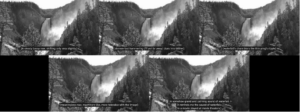
Image description: A collage of five identical stills with different sound captions. The still shows a long-distance shot of a waterfall, a canyon, and trees. Mist floats off of the waterfall, creating a scenic atmosphere.
Bill Davies
[A steady bassy roar, shifting only very slightly.]
Josephine Dickinson
[demon-fast hammering (fff yet far away) blurs into blither]
Ed Garland
[waterfall’s churn blurs the thin ping’s ripple]
Alan Jacques
[meaningless roar, machinery like, more tolerable with the image]
Terry Perdanawati
[A somehow grand and calming sound of waterfall. It reminds me the sound of waterfalls in movie played at movie theaters.]
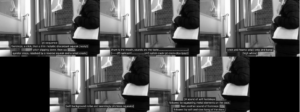
Image description: A collage of five identical stills with different sound captions. The still shows a woman wearing a winter jacket and holding a handbag opens a glass door and steps inside.
Bill Davies
[A sequence: footsteps, a click, then a thin metallic discordant squeak (nasty!): pitch dipping down, then up; quieter steps, resolved by a reverse squeak and a small crash.]
Josephine Dickinson
[hum is the mouth, sounds are the taste…………………………………………….]
[—–(ff) splicash!…………………..(mf) splish clack (p) clock-clou (ppp)]
Ed Garland
[click and hoarse yelp] [yelp and bang]
[high whine]
Alan Jacques
[soft background noise and seemingly pitchless squeaks]
Terry Perdanawati
[A sound of soft footsteps followed by squeaking metal elements on the door, then another sound of footsteps followed by soft and slow bang of the door.]
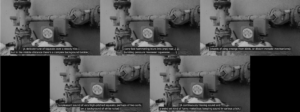
Image description: A collage of five identical stills with different sound captions. The still shows a gas pool heater with its pipelines installed right next to a wall.
Bill Davies
[A delicate tune of squeaks over a steady hiss but in the middle distance there’s a complex background babble.]
Josephine Dickinson
[very fast hammering blurs into (mp) roar…]
[building pressure: heeeeee! squeeeee……….!]
Ed Garland
[shards of ping emerge from birds, or distant metallic mechanisms]
Alan Jacques
[unpleasant sound of very high-pitched squeaks, perhaps of two sorts, on a background of white noise]
Terry Perdanawati
[A continuously hissing sound and a weird yet kind of funny melodious beeping sound in various pitch.]
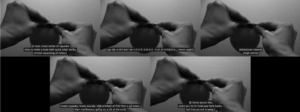
Image description: A collage of five identical stills with different sound captions. The still shows two hands pinching the mouth of an air-filled balloon against a blank backdrop.
Bill Davies
[A loud, close series of squeaks tries to make a tune with quick pitch shifts, almost vocalising at times.]
Josephine Dickinson
[ge-BE-o hih! herr he-h-h-h-h h-h-h-h h-(h-)h-h (h)(h)(h…) herrrr-eagh!]
Ed Garland
[distressed rodent]
[high whine]
Alan Jacques
[nasty squeaky, hooty sounds, high pitched at first then a git lower, then continuous, going up a bit at the end]
Terry Perdanawati
[A funny sound like when you try to hold your farts badly, but they go out anyway.]
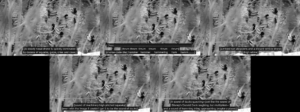
Image description: A collage of five identical stills with different sound captions. The still shows a plant-obstructed view of a raft of ducks randomly milling about a small canal.
Bill Davies
[A steady nasal drone is quickly dominated by dozens of squarks, gulps, cries and caws.]
Josephine Dickinson
[fuzz…………………………………………………………………………………………………..]
[thrum thrum thrum thrum thrum thrum]
[(morse-code-like) hammer hammer hammering ham hamm………..]
Ed Garland
[jumbled wet abrasions and a distant vehicle drone]
[high whine]
Alan Jacques
[sound of machinery high pitched squeaky]
[even with the image I couldn’t get it to be the sound of ducks]
Terry Perdanawati
[A sound of ducks quacking—just like the sound of Disney’s Donald Duck laughing, but multiplied—and a sound of humming thing approaching (maybe a plane).]
Each captioner showcases unique approaches to sound-captioning. Bill Davies, driven by his lived experience as an autistic, Hard-of-Hearing person who is a professor of psychoacoustics, wrote detailed aural events in his sound captions, which sometimes reveal his sensitivity to soft sounds.
Josephine Dickinson—driven by her lived experience as a deaf person receiving a cochlear implant who is a writer with extensive collaborations with various artists—interpreted her aural events using onomatopoeia, rhythmical syllables, poetic words, and dynamic markings from Western classical music, following her deafness and cochlear implant experience.
Ed Garland—driven by his lived experience as a person with tinnitus and Hard of Hearing who is a writer with experience analyzing sound in fiction—coupled both stimuli he perceived from outside his body and inner ringing caused by his tinnitus.
Alan Jacques—driven by his lived experience as a person having Ménière’s disease, Hard of Hearing, and almost complete inability to recognize pitch, who is a retired doctor and classical pianist playing with the psychological “inner ear”—wrote prosaic descriptions that reveal his mode of hearing with video off and on, his embodied pain, reconstructed aural memory, and dominantly unrecognizable pitch perception.
Terry Perdanawati—driven by her lived experience as a ‘normal’ hearing, who has a writing experience as a copywriter and a translator, was trained in business administration and English as a secondary language, and has worked with Jay Afrisando on his artistic projects—wrote prosaic descriptions, dominantly coupled with analogies and her memories.
The sound captions the collaborators wrote are not only diverse as expected but also showcase various and detailed listening experiences induced by the various audiovisual scenes. The sound captions show comparative perceived soundscapes toward the particular audiovisual scenes, which help viewers know how different listeners make sense of aural experiences towards the same sources. The sound captions display subjective, quirky ways of captioning, using words and punctuation to express their experiences. The sound captions reveal the spectra of experiences, offering specific contexts through brief descriptions that correspond to various audiovisual scenes.
Work Realization and Approaches to the Presentation
Since working on aural diversity, disability, access, and decolonizing the arts, I have treated my work as always “in progress.” They can convey the same spirit through various manifestations, depending on the context of the audience, space, event, and availability of equipment and funding. Each public presentation of such a work presents opportunities for the work itself to evolve, depending on the space it occupies, much like a plant of the same species that grows differently in different soils and planting times.
At this time of writing, In Which to Trust? has been presented at a number of spaces. I will mention three exhibition events that mark significant milestones for this work.
In Which to Trust? was first presented in a group exhibition at Sound Scene 2022 at the Smithsonian Hirshhorn Museum and Sculpture Garden, Washington, DC, US. The film’s duration is 5 minutes 36 seconds, looped.
With sufficient support from the festival and a grant I received, I presented the piece using five identical digital display monitors. Initially, the work was supposed to be showcased in color. However, one of the monitors glitched, so it could not produce the consistent colors with the other monitors. Perdanawati, one of the sound-captioners who also managed this project, and I decided to make the film installation black and white by completely reducing the image saturation. Not only was the visual issue resolved, but with this black-and-white mode, all the captions look more prominent.
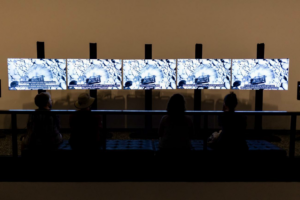
Image description: Four visitors are seated on a couch and watch a five-monitor video installation. The monitors display five identical videos of a handheld recorder being used to record humans walking on the stones, each with different sound captions. Photo credit: Anthony Washington. Event: Sound Scene 2022.
In the second iteration, In Which to Trust? was presented in a solo exhibition at Curb Appeal Gallery, an apartment gallery in Chicago, IL, US, in late 2023. The exhibition was curated by Sandy Guttman, an independent curator, writer, and artist. At that time, the project received less funding to realize the installation than the first iteration. Guttman and Todd Garon, who supported the technical installation and fabrication, designed the installation as a monitor collage using various sizes of displays. They acquired monitors thanks to donations from their network and communities. As expected, the monitors came in different sizes and color qualities. Interestingly, this approach exhibits a unique way of looking at the installation; different monitor sizes and qualities induce crip personas representing each captioner.
For this exhibition, Guttman and I decided to enhance the work with audio descriptions, narrating the film visuals in spoken form. We created the descriptions and had a narrator, Casey Palbicki, voice and record them. The descriptions not only illustrate the visuals of the video but also narrate all the sound captions. After obtaining the recording, I incorporated the audio descriptions into the film, and each clip’s duration is lengthened through looping to match the descriptions’ duration. The duration of this new version is 36 minutes, which is much longer due to the audio descriptions.
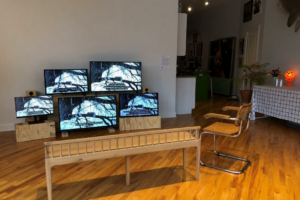
Image description: Five differently-sized monitors displaying five identical videos but with five different sound captions. Two small wooden loudspeakers are on the sides of the monitors. A wooden bench and a chair are provided for a cozy viewing. Photo credit: Terry Perdanawati. Event: is sound is tactile is visual is sound is, Curb Appeal Gallery, 2023.
Both exhibition events invited visitors from diverse backgrounds in knowledge, professions, bodies, and ages to curiosity and questions about aural perception, soundscape, and aural diversity. This became more apparent at the exhibition event at the UCSC (University of California, Santa Cruz) Institute of the Arts and Sciences, CA, US, in early 2024. The institute curator, Dr. Rachel Nelson, put the installation at the building entrance, which led to Al-Haq Forensic Architecture Investigation Unit’s visual investigation work They are shooting at our shadows and Maria Gaspar’s video footage and installation work Compositions inside the building. This way, In Which to Trust? began the visitor’s journey to recognize the political aspects of hearing-listening driven by body differences, leading to the expansion of hearing-listening notion as an act of witnessing to address legal accountability and collective struggle against genocide and carceral systems.
This exhibition event was accompanied by an artist talk, where I shared how In Which to Trust? came into being. This talk shared the importance of recognizing and accepting aural diversity in all aspects of life, including revisiting and unlearning our way of hearing-listening, and allowing ourselves to be vulnerable to become more open to hearing-listening aural differences. After this talk, some visitors had conversations with me and expressed their rediscovered interests in hearing-listening; some of them admitted that they did not notice how crucial it is to recognize and accept aural differences, whereas others shared how they had masked as they needed to thrive in an ableist environment.
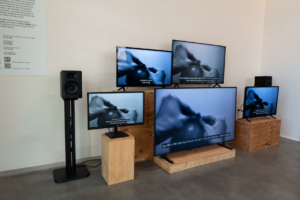
Image description: Five differently-sized monitors display five identical videos of two hands pinching the mouth of an exhaling balloon, each with a different sound caption. The monitors are placed on different plinth sizes, forming a collage. Two small loudspeakers are on the sides of the monitors. Photo credit: Louise Leong, UCSC Institute of the Arts and Sciences, 2024.
Temporary Conclusions
In Which to Trust? exhibits comparative experiences of aural perceptions of the same stimuli through an artistic form as an alternative method of sharing. The form of the research project makes it more accessible for the general public to learn about the way people with diverse hearing-listening profiles understand soundscape and the existence of aural diversity.
The sound captions, as a form of the captioners’ interpretation of their lived experiences towards the soundscape, reveal a whole new world of sounds facilitated by their hearing-listening characteristics and conditions. Instead of limiting, the captions’ brevity—coupled with the audiovisual scenes—reveals the potential of alternative ways for us, aurally diverse people, to revisit how we actually hear-listen and redefine the meaning of sound. Sound captions as lived experiences become an essential form of knowledge.
I want to emphasize that alternative does not mean secondary nor the opposite of the center. It may signify a paradigm shift driven by sociocultural movements; a tool, pathway, method, or effort to better interpret an environment; or a horizon of possibilities and hopes to recreate a better version of ourselves (Juliastuti 2022, 9-10).
This project has demonstrated that arts-based research offers an innovative way to create alternative knowledge through collaboration, making knowledge sharing more approachable and inviting. The collaborative nature of this project opens up a new possibility to develop the work with new aurally diverse collaborators and methodologies in the future.
References
Bibliography
Adams, Jeff, and Allan Owens. 2021. “Introduction.” In Beyond Text: Learning through Arts-Based Research, edited by Jeff Adams and Allan Owens. Intellect.
Clark, Andy. 2013. “Whatever next? Predictive Brains, Situated Agents, and the Future of Cognitive Science.” Behavioral and Brain Sciences 36 (3): 181–204. https://doi.org/10.1017/S0140525X12000477.
Drever, John Levack, and Andrew Hugill, eds. 2022. Aural Diversity. Routledge.
Juliastuti, Nuraini. 2022. Alternatif sebagai strategi: akses, infrastruktur & pengetahuan. Edisi pertama. Kunci Study Forum & Collective.
Leavy, Patricia. 2020. Methods Meets Art: Arts-Based Research Practice. Third edition. The Guilford Press.
Shinn-Cunningham, Barbara G. “Object-Based Auditory and Visual Attention.” Trends in Cognitive Sciences 12, no. 5 (2008): 182–86. https://doi.org/10.1016/j.tics.2008.02.003.
Sterne, Jonathan. 2015. “Hearing.” In Keywords in Sound, edited by David Novak and Matt Sakakeeny. Duke University Press.
Warren, Richard M., and Roslyn P. Warren. 1968. Helmholtz on Perception: Its Physiology and Development. John Wiley + Sons.
Artistic Works
Afrisando, Jay. n.d.a. “In Which to Trust?” Jay Afrisando. Accessed December 15, 2025. https://www.jayafrisando.com/works/in-which-to-trust.
Afrisando, Jay. n.d.b. “In Which to Trust?: With Visual Description.” Jay Afrisando. Accessed December 15, 2025. https://www.jayafrisando.com/works/in-which-to-trust-with-visual-description.